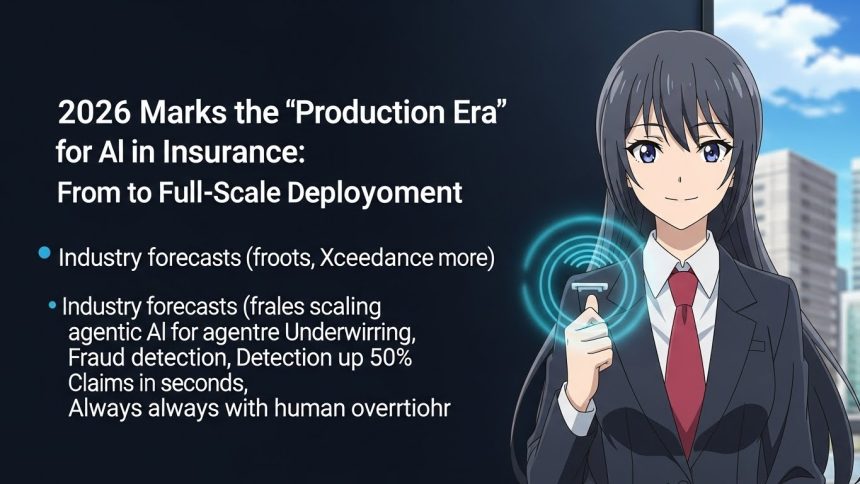
Insurers Move Beyond Experiments as Agentic AI Enters Real-Time Underwriting, Fraud Detection, and Claims—With Humans Still in the Loop
Introduction: AI Grows Up in Insurance
For years, artificial intelligence in insurance lived in pilot programs, innovation labs, and carefully fenced experiments. Promising demos rarely translated into real-world scale.
That changes in 2026.
According to industry forecasts from consulting and analytics leaders including Roots, Xceedance, Cognizant, and others, insurers are entering what many now call the “Production Era” of AI—a phase where AI systems move decisively from testing environments into core operational workflows.
This isn’t about experimentation anymore.
It’s about execution—at scale, under regulation, and with real financial and human consequences.
What the “Production Era” Actually Means
The Production Era signals a shift from:
- AI as a support tool
- AI as an experiment
- AI as a future promise
to:
AI as a live, accountable component of insurance operations—always paired with human oversight.
Insurers are no longer asking if AI can work.
They’re asking how fast it can be deployed responsibly.
Agentic AI Moves Into the Core of Insurance
A defining feature of this era is the rise of agentic AI—systems capable of:
- Taking goal-oriented actions
- Coordinating across workflows
- Making recommendations in real time
- Escalating to humans when thresholds are crossed
Unlike static models, agentic AI can operate continuously across underwriting, claims, and fraud detection—without fully removing humans from decision-making.
This “human-in-the-loop” design is now considered essential in a high-risk industry like insurance.
Real-Time Underwriting Becomes Reality
One of the most transformative changes is real-time underwriting.
Instead of days or weeks, AI systems can now:
- Analyze applicant data instantly
- Cross-check risk factors
- Suggest pricing and coverage terms
- Flag edge cases for human review
This dramatically reduces friction for customers while allowing underwriters to focus on complex, high-value decisions—not routine approvals.
The result: faster onboarding without abandoning professional judgment.
Fraud Detection Jumps by 50%
Industry projections indicate that AI-driven fraud detection rates are improving by as much as 50% as systems mature and scale.
Modern AI models can:
- Detect subtle behavioral anomalies
- Identify fraud rings across policies
- Analyze unstructured data like text and images
- Continuously learn from new fraud patterns
Crucially, flagged cases are still routed to human investigators, ensuring that cost savings don’t come at the expense of fairness or due process.
Claims Processing in Seconds, Not Weeks
Claims is where the Production Era becomes most visible to customers.
In 2026, AI-enabled systems are increasingly capable of:
- Validating claims instantly
- Extracting data from documents and photos
- Estimating payouts in real time
- Approving straightforward claims in seconds
For more complex or sensitive cases, AI acts as a decision-support engine, not a final authority.
This hybrid model reduces backlogs while preserving accountability.
Why Human Oversight Is Non-Negotiable
Every major forecast agrees on one thing:
AI in insurance must remain supervised.
Insurance decisions affect:
- Financial security
- Access to care
- Legal rights
- Long-term trust
That’s why leading insurers are embedding:
- Mandatory human review thresholds
- Explainability requirements
- Audit trails for AI decisions
- Escalation paths for edge cases
Automation without oversight is no longer considered acceptable—or legally safe.
Regulation Is Accelerating This Shift
Regulators worldwide are treating insurance AI as a high-risk use case, pushing companies toward production-ready systems that are:
- Transparent
- Auditable
- Governed by clear accountability
Ironically, this regulatory pressure is accelerating adoption—because insurers can no longer afford fragmented pilots. They need robust, compliant systems that work end-to-end.
Operational Impact: Fewer Silos, Faster Decisions
The Production Era is also breaking down internal silos.
AI systems now connect:
- Underwriting data
- Claims history
- Fraud intelligence
- Customer interactions
This creates a unified operational view, allowing insurers to act faster and more consistently—while reducing manual handoffs that historically caused delays and errors.
What This Means for Insurance Professionals
AI at production scale changes roles—but doesn’t eliminate them.
The highest demand is shifting toward:
- Oversight and validation
- Complex risk assessment
- Ethical and regulatory judgment
- AI governance and monitoring
Routine tasks shrink. Decision quality and accountability grow in importance.
The future insurance professional is AI-augmented, not AI-replaced.
The Strategic Stakes Are High
Insurers that fail to move into production risk:
- Higher operating costs
- Slower customer experiences
- Weaker fraud defenses
- Competitive disadvantage
Those that move too fast—without safeguards—risk:
- Regulatory penalties
- Public trust collapse
- Legal exposure
The winners in 2026 will be those who balance speed, scale, and responsibility.
Final Verdict: AI Stops Being a Bet—and Becomes Infrastructure
2026 marks a clear transition.
AI in insurance is no longer a side project or innovation headline.
It’s becoming core infrastructure, embedded in underwriting, claims, and fraud detection—always under human supervision.
The Production Era isn’t about replacing people.
It’s about finally deploying AI where it belongs:
handling volume, surfacing insight, and freeing humans to make the decisions that truly matter.
The experiment phase is over.
Insurance has entered the age of operational AI.