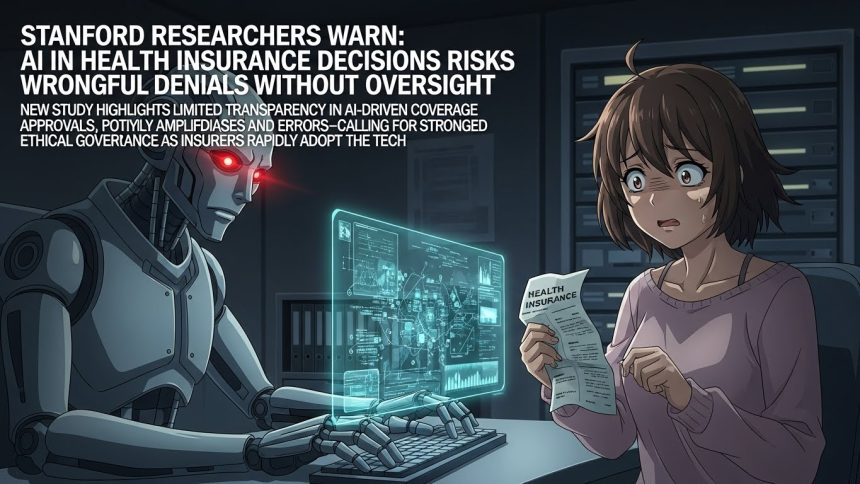
Lack of Transparency in AI-Driven Coverage Approvals Could Amplify Bias, Errors, and Harm, Study Finds
Introduction: When Algorithms Decide Who Gets Care
Artificial intelligence is rapidly moving from back-office automation into one of the most sensitive areas of modern life: health insurance decisions.
Now, researchers from Stanford University are raising a serious red flag.
According to a new academic analysis, the growing use of AI systems to assist or automate health insurance coverage decisions—such as prior authorizations, claim approvals, and treatment eligibility—risks wrongful denials, hidden bias, and systemic errors unless strict oversight and ethical governance are enforced.
In a system where a single decision can determine whether a patient receives life-saving care, the stakes could not be higher.
What the Stanford Researchers Are Warning About
The Stanford research highlights a core problem with AI in health insurance:
Decisions are increasingly made by systems that are opaque, difficult to audit, and poorly understood by the people affected by them.
The study warns that many AI-driven tools used by insurers operate as black boxes, offering:
- Limited explanation for why coverage is approved or denied
- No clear accountability when errors occur
- Minimal opportunity for patients to challenge decisions
As insurers accelerate AI adoption to cut costs and speed up workflows, these systems risk scaling mistakes at industrial levels.
How AI Is Being Used in Health Insurance Today
Health insurers are deploying AI across multiple decision points, including:
🧠 Prior Authorization
AI systems evaluate whether a requested treatment meets policy criteria—often before a human reviews it.
📄 Claims Review
Algorithms scan medical codes, patient histories, and cost models to flag or reject claims.
📊 Risk Scoring
Machine learning models assess patient risk profiles, influencing coverage terms and approvals.
While insurers argue this improves efficiency, Stanford researchers caution that efficiency without accountability can harm patients.
The Transparency Problem: “Why Was I Denied?”
One of the most troubling findings is the lack of explainability.
Patients and even healthcare providers often receive:
- Generic denial reasons
- Automated responses
- No clear insight into how the decision was made
When AI systems are trained on historical insurance data, they may inherit:
- Past biases
- Cost-driven assumptions
- Unequal treatment patterns
Without transparency, errors become invisible—and therefore uncorrectable.
Bias Amplification: Old Problems, New Scale
The Stanford analysis warns that AI does not eliminate bias—it can amplify it.
If training data reflects:
- Socioeconomic disparities
- Unequal access to care
- Historical under-treatment of certain groups
Then AI systems may reinforce those patterns automatically.
In health insurance, this can translate into:
- Disproportionate denials for vulnerable populations
- Reduced access to specialized or expensive treatments
- Systematic disadvantage masked as “objective automation”
Why Health Insurance Is a “High-Risk” AI Use Case
Unlike recommendation algorithms or ad targeting, health insurance decisions have direct medical consequences.
A delayed or denied claim can mean:
- Missed treatment windows
- Financial ruin for families
- Worsening health outcomes
- Loss of trust in healthcare systems
Stanford researchers emphasize that health insurance AI should be treated as a high-risk system, requiring stricter controls than typical enterprise automation.
The Push for Stronger Ethical Governance
The study calls for urgent reforms, including:
✅ Mandatory Human Oversight
AI should assist—not replace—human decision-makers in coverage approvals.
✅ Explainability Requirements
Patients must be able to understand why a decision was made.
✅ Independent Audits
Regular third-party audits should test for bias, error rates, and unfair outcomes.
✅ Clear Accountability
Insurers—not algorithms—must be legally responsible for wrongful denials.
Without these safeguards, researchers warn that AI could quietly reshape health insurance into a system that prioritizes cost containment over patient care.
Why Insurers Are Still Rushing Forward
Despite the warnings, insurers continue to adopt AI aggressively because:
- Claims volumes are rising
- Administrative costs are high
- Automation promises speed and savings
But the Stanford researchers argue that speed cannot come at the expense of justice, fairness, and patient safety.
Once AI-driven denial systems are deeply embedded, reversing harm becomes far more difficult.
The Broader Implication: Trust in Healthcare Systems
This debate isn’t just about technology—it’s about trust.
If patients believe that:
- Algorithms are quietly denying care
- Decisions can’t be challenged
- Humans are no longer accountable
Then confidence in health insurance—and healthcare itself—will erode.
That trust, once lost, is extremely hard to rebuild.
Final Verdict: A Critical Moment for AI in Healthcare
The Stanford warning arrives at a crucial time.
AI in health insurance is no longer experimental—it’s operational.
And with that shift comes responsibility.
Without transparency, oversight, and ethical governance, AI risks turning healthcare coverage into an automated gatekeeping system, where errors scale faster than justice.
The message from researchers is clear:
AI may optimize systems—but only humans can protect patients.
The choices insurers and regulators make now will define whether AI becomes a tool for better healthcare—or a silent barrier to it.want to publish it.