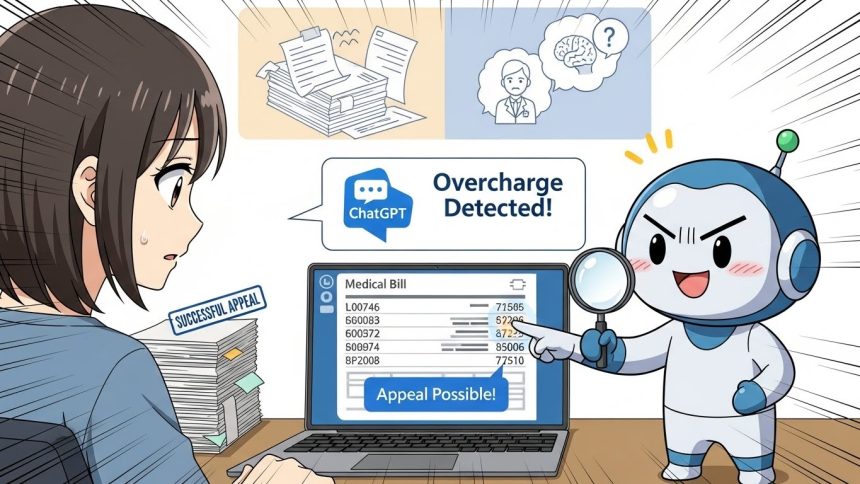
Viral Use of AI for Medical Bills and Insurance Disputes Boosts Efficiency—but Sparks Serious Safety Concerns
Introduction: When Patients Turn to AI for Help the System Won’t Give
For millions of patients, medical bills are confusing, intimidating, and often filled with errors. Insurance denials arrive with vague explanations. Appeals feel impossible without legal or medical expertise.
So patients are trying something new.
Across social media, viral stories show people uploading medical bills, explanation-of-benefits (EOB) statements, and denial letters to ChatGPT, asking it to:
- Identify billing errors
- Flag potential overcharges
- Explain insurance jargon
- Draft appeal letters
For many, the results feel empowering—fast, clear, and far more understandable than insurer responses.
But as this trend accelerates, doctors, insurers, and mental health professionals are raising alarms about the risks of relying on AI for medical and insurance advice.
Why Patients Are Using ChatGPT for Medical Bills
The healthcare billing system is notoriously opaque.
Common patient complaints include:
- Duplicate charges
- Incorrect procedure codes
- Services never received
- Out-of-network surprises
- Denials with no clear reasoning
ChatGPT offers something patients rarely get: plain-language explanations.
Users report that the AI can:
- Translate complex CPT and ICD codes
- Highlight suspicious line items
- Explain why an insurance claim might have been denied
- Draft structured, professional appeal letters
For overwhelmed patients, this feels like finally having an advocate.
The Appeal Advantage: Faster, Clearer, Less Intimidating
One of the most popular uses is insurance appeals.
Patients upload denial notices and ask ChatGPT to:
- Summarize the insurer’s reasoning
- Identify missing documentation
- Suggest appeal arguments
- Write formal appeal letters
Compared to navigating insurer portals or waiting on hold, AI assistance feels dramatically more efficient.
Some users report successful reversals after submitting AI-assisted appeals—fueling the perception that ChatGPT is becoming a powerful patient-side tool.
Why Experts Are Worried: Accuracy Is Not Guaranteed
Despite the benefits, experts caution that ChatGPT is not a medical professional, lawyer, or licensed insurance advocate.
The biggest risks include:
⚠️ Misinterpreting Medical Necessity
AI may misunderstand why a treatment was denied, especially in complex cases.
⚠️ Incorrect Coding Advice
Healthcare billing codes are highly specific. A small error can invalidate an appeal.
⚠️ Overconfidence in AI Output
Patients may treat AI-generated explanations as authoritative—even when they’re incomplete or wrong.
Unlike human experts, AI doesn’t know when it’s uncertain.
Mental Health: The Highest-Risk Area
The most serious concerns center on mental health claims.
Mental health coverage decisions often involve:
- Subjective assessments
- Clinical nuance
- Regulatory complexity
Experts warn that AI-generated advice in mental health cases could:
- Oversimplify diagnoses
- Misrepresent treatment necessity
- Encourage appeals that unintentionally harm a patient’s case
- Provide false reassurance in emotionally vulnerable situations
There’s also concern that patients may rely on AI for emotional validation when facing denials—blurring the line between administrative help and psychological support.
Privacy and Data Security Questions
Another unresolved issue: data safety.
Uploading medical bills means sharing:
- Diagnoses
- Treatment histories
- Provider information
- Insurance identifiers
While AI platforms emphasize privacy protections, experts caution that patients should:
- Remove identifying details where possible
- Avoid uploading full medical records
- Understand that AI tools are not HIPAA-covered providers
The convenience comes with tradeoffs.
Why This Trend Is Exploding Now
Several forces are driving this behavior:
- Rising healthcare costs
- Increasing claim denials
- Short-staffed insurer support systems
- Growing trust in conversational AI
- Lack of affordable patient advocates
In many cases, patients turn to ChatGPT not because it’s perfect—but because the system gives them no better option.
What Healthcare and Insurance Leaders Are Saying
Insurers and providers acknowledge the frustration—but urge caution.
Many emphasize:
- AI tools should assist, not replace, professional guidance
- Appeals should still be reviewed by qualified experts
- Mental health cases require special care
Some insurers are even exploring their own AI tools for claim explanations—raising concerns about an AI-versus-AI future, where patients and insurers rely on competing algorithms.
The Bigger Picture: AI Filling a Systemic Gap
This trend highlights a deeper problem.
Patients aren’t turning to AI because they love technology—they’re turning to it because:
- Billing systems are broken
- Transparency is lacking
- Human support is inaccessible
ChatGPT is filling a gap the healthcare system created.
But filling a gap doesn’t mean it should replace accountability.
A Sensible Middle Ground
Experts increasingly recommend a hybrid approach:
✅ Use AI to understand bills and terminology
✅ Use AI to draft appeals—but verify facts
✅ Consult professionals for complex or mental health cases
❌ Do not treat AI as a final authority
AI can empower patients—but only when used responsibly.
Final Verdict: Helpful Ally or Risky Shortcut?
ChatGPT’s rise as a patient “ally” reflects both the power of AI and the failures of healthcare administration.
For decoding bills and organizing appeals, AI can be a powerful assistant.
For medical judgment—especially mental health—it remains a risky substitute.
The technology isn’t the villain.
But blind trust could be.
As AI becomes more embedded in healthcare workflows, the challenge will be ensuring it supports patients without misleading or endangering them.
The future isn’t AI instead of experts—it’s AI alongside them.